


Warehouse Ergonomics: Reduce Lifting Injuries
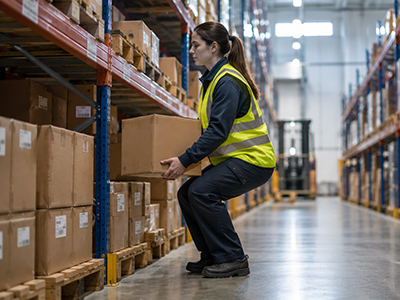
Few work environments demand as much from the human body as a warehouse. Over the course of a single shift, an associate may lift several hundred cases, walk multiple miles of aisle, reach above shoulder height dozens of times, and bend to floor level just as often. Each individual motion looks unremarkable. Multiplied across a shift, a week, and a career, those motions become the leading source of lost workdays in distribution and fulfillment operations.
The instinct in most facilities is to treat this as a behavior problem. Post the lifting poster, run the annual safety talk, remind people to bend their knees. That approach has been tried in warehouses for decades, and injury rates have stubbornly refused to follow. The more durable answer is to treat it as a design problem: change the height of the pick, reduce the distance of the reach, and eliminate the lift entirely wherever the operation allows. Let’s look at where warehouse injuries actually come from and what genuinely reduces them.
Why Warehouse Work Carries Elevated Injury Risk
The physical demands of manual material handling
Manual material handling combines nearly every recognized ergonomic risk factor into one task. Force is present in the weight of the load. Awkward posture appears in the bend, twist, or overhead reach required to access it. Repetition arrives through volume. Static loading shows up in the seconds spent holding a case steady while a scanner confirms the pick. Any one of these factors in isolation is manageable. Warehouse work routinely stacks three or four of them into the same motion, and the combination is what drives risk upward rather than any single element.
What makes this difficult for operations leaders is that the risk is not evenly distributed. Two associates performing what appears to be the same job may face very different exposures depending on their assigned zone, the products they handle, and their own body dimensions. A five-foot-two picker working a warehouse designed around a five-foot-ten average is reaching overhead on shelves a taller colleague accesses at chest height. The job description is identical; the physical demand is not.
How repetition compounds small stresses
Tissue damage in the warehouse rarely announces itself. Tendons, discs, and muscles accumulate microtrauma faster than the body repairs it, and the resulting musculoskeletal disorders develop over weeks or months rather than in a single dramatic moment. This is why the injury report so often lists a trivial cause. The associate who reports a back strain after lifting an empty tote was almost certainly not injured by the tote. The tote was simply the last load applied to tissue that had been quietly degrading for a long time.
This slow-accumulation pattern has an important implication for management. Waiting for injury reports to identify problem areas means waiting until damage has already occurred. Discomfort surveys, near-miss reporting, and direct task observation surface the same problems considerably earlier, while the intervention is still cheap and the associate is still healthy.
The real cost of a single warehouse injury
The financial argument for warehouse ergonomics is more compelling than most operators assume. Direct workers’ compensation costs represent only the visible portion of the expense. Behind them sit overtime to cover the absence, temporary staffing, retraining, reduced throughput while a modified-duty associate works at partial capacity, and the administrative burden of managing the claim. Taken together, the true cost of a single musculoskeletal injury frequently reaches five figures and can climb considerably higher when a claim becomes long-term.
Set against that number, most ergonomic interventions in a warehouse are inexpensive. Adjusting slotting logic costs staff time. Adding a lift table to a repack station costs less than a fraction of one back claim. The economics generally favor prevention by a wide margin, provided the intervention is aimed at the right task.
Understanding Lifting Injuries in the Warehouse
What happens to the spine during a lift
When an associate bends forward to lift a case, the spine functions as a lever with a very short resistance arm. The lower back muscles attach only a couple of inches from the spinal column, while the load sits well out in front of the body. The result is a mechanical disadvantage of roughly ten to one: a forty-pound case held at arm’s length can generate several hundred pounds of compressive force through the lumbar discs. The associate feels forty pounds. The spine experiences something far greater.
This is the single most useful concept to communicate to a warehouse workforce, because it explains why load weight alone is a poor predictor of injury. A light box handled badly can be more damaging than a heavy one handled well. The variable that matters most is not what the load weighs but how far it sits from the body when the lift begins.
The role of load weight, position, and frequency
Professional lifting analysis evaluates several variables together rather than in isolation. Horizontal distance from the body drives spinal compression. Vertical starting height determines whether the lift begins from a deep squat, a comfortable mid-range, or an overhead reach. Vertical travel distance measures how far the load must move. Trunk rotation during the lift adds shear force to compression. Frequency and shift duration determine whether tissue gets any recovery time. Coupling quality, meaning how securely the hands can grip the load, affects how much of the effort is wasted on holding rather than lifting.
Changing any one of these variables reduces risk, but the highest-leverage adjustments are usually vertical starting height and horizontal distance. Moving a fast-moving SKU from a floor-level pick to knuckle height eliminates a deep bend on every single transaction, and it costs nothing but a slotting change.
Why “lift with your legs” isn’t enough
Proper lifting technique is worth teaching, and it belongs in every warehouse onboarding curriculum. It is simply not sufficient on its own. Technique degrades under time pressure, and warehouse work is almost always paced. It degrades further with fatigue, which means it fails precisely during the final hours of a shift when injury risk peaks. And it cannot overcome a task that is poorly designed to begin with, because no technique allows an associate to safely retrieve a heavy case from an overhead shelf.
The established hierarchy of controls places engineering solutions above administrative ones for exactly this reason. Eliminate the hazardous lift where possible. Where elimination is not possible, redesign the task to reduce the demand. Only then rely on training and technique to manage what remains. Facilities that invert this order tend to accumulate injuries while their training records look excellent.
Reaching, Bending, and Overhead Work
Horizontal reach and the strike zone
The safest zone for handling material sits between mid-thigh and mid-chest, close to the body and within easy arm’s reach. Work performed inside this window keeps the spine neutral and the shoulders relaxed. Work performed outside it forces compensation somewhere in the kinetic chain. Yet in most warehouses, storage decisions are driven by cube utilization and product velocity, with the human reach envelope treated as an afterthought if it is considered at all.
Reviewing pallet and shelf placement against this zone often produces immediate wins. Deep shelving that requires an associate to lean fully into a rack, conveyor lines positioned just beyond comfortable reach, and pack stations where supplies sit at the far edge of the bench all create sustained forward reaching that would be trivial to correct.
Overhead reaching and shoulder strain
Overhead work carries a specific and often underestimated risk. Raising the arm above shoulder height compresses the space through which the rotator cuff tendons pass, and adding load to that position accelerates wear substantially. Shoulder injuries also tend to be more expensive and slower to resolve than back strains, frequently requiring surgical repair and extended recovery.
The practical control is straightforward: heavy and frequently picked items should never be stored above shoulder height. Reserve upper levels for light, slow-moving inventory, and provide platform steps or lift assists wherever elevated access is genuinely unavoidable.
Low reaching and floor-level picks
Floor-level work receives less attention than overhead reaching but generates comparable exposure. Picking from the bottom slot of a rack, retrieving items from a floor pallet, or working from a low tote all require either a deep squat or a full forward bend, and under production pressure associates almost always choose the bend. Repeated across a shift, this is one of the most reliable predictors of lower back complaints in a distribution center.
Pallet stands, spring-loaded lift tables, and tilting containers raise the work surface into the safe zone and remove the bend entirely. These are among the least expensive interventions available and among the most consistently effective.
Engineering Controls That Reduce Risk at the Source
Rethinking storage height and slotting
Slotting strategy is the highest-leverage ergonomic tool most warehouses already possess and rarely use for this purpose. Placing the fastest-moving and heaviest SKUs between knee and shoulder height means the majority of daily transactions occur in the safest posture available. Slower-moving and lighter items absorb the less favorable positions, where the exposure frequency is low enough to matter far less.
This kind of change requires no capital expenditure and no new equipment. It requires a willingness to weight ergonomic exposure alongside travel efficiency when slotting decisions are made, which is largely a matter of who is in the room when those decisions get set.
Lift assists, carts, and conveyors
Mechanical assistance removes the lift rather than improving it. Vacuum lift assists handle cases and sheet goods without manual grip. Scissor lift tables keep a pallet’s working surface at a constant height as layers are removed. Powered stackers, gravity conveyors, and well-maintained carts move material horizontally without carrying. Each of these transfers load from human tissue to equipment, which is the only intervention that reliably reduces exposure to zero.
Deployment matters as much as purchase. Assist equipment that is stored inconveniently, poorly maintained, or slower than doing the job by hand will sit unused, and the operation will have paid for a control it never received. Placement, maintenance, and honest attention to cycle time determine whether the investment produces any return.
Workstation and packing station design
Packing, sorting, and quality inspection stations are frequently the most static positions in a warehouse, and the most easily corrected. Adjustable-height benches accommodate different body sizes and allow sit-stand alternation. Turntables eliminate the trunk rotation that would otherwise accompany every carton. Positioning tape guns, labels, and dunnage within the primary reach zone removes hundreds of small stretches per shift.
Because these stations are fixed and highly repetitive, they reward detailed analysis better than almost any other area of the operation. A structured ergonomic assessment of a single high-volume pack station often surfaces a dozen small corrections that collectively transform the position.
Flooring, footwear, and standing surfaces
Concrete floors offer no shock absorption, and associates who spend eight to twelve hours standing on them accumulate fatigue in the feet, knees, hips, and lower back. Anti-fatigue matting at fixed stations, supportive footwear guidance, and attention to floor condition in high-traffic aisles all reduce that cumulative load. Fatigue is not merely a comfort issue in a warehouse; a tired associate handles the next case with worse mechanics than a rested one, which makes fatigue management a genuine injury control.
Administrative Controls and Work Organization
Task rotation and recovery
Where engineering controls cannot fully eliminate exposure, thoughtful work organization limits how long any individual stays in it. Effective rotation moves associates between tasks that load genuinely different tissues, not merely between different stations performing the same motion. Rotating a picker from one aisle to another accomplishes very little. Rotating from picking to a station-based task with a different demand profile accomplishes a great deal.
Recovery time works similarly. Brief, frequent pauses allow tissue to recover more effectively than a single long break placed mid-shift, and they cost less throughput than most operators expect.
Team lifting and load limits
Clear, enforced thresholds for when a lift requires a second person or a mechanical assist remove ambiguity from a decision associates otherwise make under time pressure. Those thresholds only work if the culture supports them, which means supervisors must visibly back an associate who stops to find help rather than treating the pause as a productivity problem.
Identifying where risk actually concentrates
Facilities frequently discover that a disproportionate share of their injury exposure comes from a small number of tasks or zones. Stress-mapping identifies where physical and operational strain concentrates across a facility, which allows limited budget and attention to be directed at the areas generating the most risk rather than distributed evenly across an operation where most positions are already acceptable.
Training That Actually Changes Behavior
Moving beyond one-time orientation
A single lifting demonstration during onboarding produces very little lasting change. Effective workplace ergonomics training is specific to the tasks an associate actually performs, delivered where the work happens rather than in a conference room, and reinforced regularly enough that it competes with the habits formed during production pressure.
Content matters as much as delivery. Explaining why a load held away from the body multiplies spinal force gives an associate a principle they can apply to a novel situation. Reciting a five-step lifting sequence gives them something to forget by the second week.
Supervisor and lead involvement
Frontline supervisors determine whether ergonomic practice survives contact with a shift. If a lead reinforces safe methods and models them personally, the training holds. If the same lead signals that speed matters more, associates will read that signal accurately and behave accordingly. Supervisor-specific training that addresses this dynamic directly is often the difference between a program that works and one that exists on paper.
Reinforcement and refresher cadence
Skills decay, staff turn over, and processes change. Establishing a sensible refresher schedule keeps ergonomic practice current, and pairing formal sessions with brief pre-shift reminders keeps it present in daily work rather than filed away as an annual compliance exercise. E3’s training programs are built around this pattern, combining initial instruction with structured reinforcement and follow-up.
Building a Complete Warehouse Ergonomics Program
Starting with assessment and data
Effective programs begin with observation rather than assumption. A thorough industrial ergonomics assessment evaluates actual tasks as they are performed, quantifies risk using validated tools, incorporates associate feedback about discomfort, and reviews injury history to identify patterns. The result is a prioritized list of tasks ranked by exposure, which allows an operation to direct resources where they will produce measurable change.
Extending ergonomics beyond the four walls
Warehouse operations rarely stop at the dock door. Drivers, delivery associates, and yard personnel spend substantial portions of their day seated in vehicles, and they face a risk profile the facility assessment never touches: prolonged static seating, whole-body vibration, awkward entry and exit, and the frequent combination of a long drive immediately followed by manual unloading. That last sequence deserves particular attention, because spinal tissue is measurably more vulnerable immediately after extended sitting.
E3’s vehicle ergonomic assessment services address this gap directly. Consultants take body measurements while an associate is seated in their vehicle, coach proper seat, mirror, and steering wheel adjustment, and produce a custom report with immediate recommendations. Evaluations can be delivered virtually through video conferencing or in person at a facility or dealership, and customized webinars cover pre-drive stretching and vehicle selection guidance for fleet purchasing decisions.
Tracking results over time
Sustainable programs measure both leading and lagging indicators. Injury rates, claim costs, and lost workdays confirm outcomes after the fact. Assessment completion rates, discomfort survey trends, control implementation, and training coverage show whether the program is functioning while there is still time to adjust. Reviewing both together turns ergonomics from an annual initiative into an operational discipline that improves year over year.
Designing the Warehouse Around the People In It
Warehouse injuries are not an unavoidable cost of moving freight. They are the predictable output of tasks designed without adequate attention to human physical limits, and they respond reliably to changes in how that work is arranged. Lower the pick. Shorten the reach. Remove the lift where the operation allows it. Train people in principles rather than scripts, and support those principles from the supervisor level down.
The operations that succeed at this treat ergonomics as an ongoing element of facility design and process improvement rather than a response to claims already filed. The investment is modest, the returns show up in both injury data and throughput, and the associates on the floor notice the difference well before the numbers do.
Ready to reduce lifting and reaching injuries in your facility? Contact E3 Consulting today for a professional assessment of your warehouse operation. Our certified ergonomic specialists will identify your highest-risk tasks, recommend practical controls, and help you build a program that protects your workforce and your bottom line.


